1st September 2026
There are several factors at play here. Big technology companies are issuing increasing volumes of debt, which act as competition for government bonds. Combined with the actual size of the US debt burden and the normalisation of interest rates, bond yields are being pushed higher while the market’s inflation expectations remain fairly conservative, despite ongoing elevated oil prices.
The US Treasury Secretary Scott Bessent has attempted to bring yields back down through treasury bond purchases and this clearly shows the US administration is worried about higher long term borrowing costs. Part of this will stem from growth (interest costs are increasingly becoming a larger part of GDP) and part of this because of the upcoming mid-term elections (political action). The long end of the yield curve is controlled by market forces and not by monetary policy or the Treasury, and until fundamentals improve we will likely see yields continuing to rise.
This isn’t just a US problem but one we are also seeing in UK and European yields, with their respective government bond real yields also rising. We think this is the continued normalisation of the interest rate environment but structural changes to things like pensions and the rise of private assets are also adding to the floor under yields.
It makes sense in our view that borrowing costs are higher. Quantitative easing ended and interest rates are higher, which makes capital more scarce. At the same time the demand for capital is increasing with equity levels high, government deficits rising, and various technology buildouts happening such as AI and clean energy, all while deglobalisation continues and conflicts cut off access to commodities. When supply is lower and demand is higher rates will go up, and this is what we are seeing. The directing of capital to the most attractive opportunities is the primary function of capital markets. The issue in our view isn’t this but rather whether investors have properly assessed the most attractive opportunities and what the future earnings potential will be.
It also calls into question what will happen if Federal Reserve Chairman Kevin Warsh shrinks the Fed balance sheet (reducing the availability of capital and causing friction with Scott Bessent’s purchases of bonds). Long term bond yields will continue to be volatile and duration isn’t adequately priced yet. To get yields back down governments will need to cut spending or increase taxes. We don’t see them being able to grow their way out of a deficit because growth in the US is already fairly good and all the while, the deficit keeps increasing. At some point something has to give. We are in a leverage-fuelled economy.
Inflation in Japan rose from 1.6% in June to 1.9% in July, reinforcing market expectations for a 0.25% rate increase at the Japanese Central Bank’s next meeting in September. This would help with the weaker Yen in currency markets but also puts pressure on US treasury yields. Investors holding Japanese government bonds will be experiencing what other global investors had in 2022 – losses on bonds from rising rates. If Japan can contain inflation the magnitude will be a lot lower though.
While long term bond yields are being pushed higher by fundamental issues, we still feel inflation is supporting shorter yields via expected future interest rate rises.
It has been clear this summer that crop yields have been impacted by the dry weather, and with a ‘super’ El Nino predicted in the second half of the year, this could bring increased droughts, wildfires and flash flooding, further impacting crops and food inflation. Markets seem to be ignoring this however, as there isn’t anything central banks can do to control food prices.
Natural gas storage in Europe is below the historic average capacity at this time of year and with the colder weather incoming it could again turn into a natural gas issue if the conflict in Iran continues. There are some differences with 2022 including an increase in clean energy usage, which don’t make the situation clear cut.
Aside from bonds and inflation, European companies in the STOXX Europe 600 index grew earnings at an estimated 14% in the first two quarters, despite the market narrative that European companies are struggling. There is undoubtedly competition from China and the ever-present regulatory burden that European companies face, and if we see natural gas shortages in the winter earnings growth will slow. But investors are favouring European companies with inflows into stocks at their highest level for five years according to data from Goldman Sachs. With technology not as prominent in Europe it could again be a diversifying trade away from the US.
Despite concerns from a top-down view, there are still attractively-valued companies with strong growth prospects across both equity and bond markets.
–
Areas of focus
- Government bond yields continue to rise as competition for capital and government debt burdens increase, with no concrete plans to reverse this.
- While high yield spreads remain compressed, investment grade corporate bond spreads have widened, highlighting the influence that technology companies are increasingly having on bond indices.
- High yield bond indices are distorted with many of the lower rated companies turning to private credit instead, where covenants and payment terms are more flexible, such as payments in kind (akin to a default in public markets).
- UK equities continue to deliver positive performance despite political risks remaining high and bond yields rising.
- The US Dollar has weakened versus a basket of major currencies as investors question Scott Bessent’s signals and actions.
- Despite a brief jump in its value, gold still remains far below its YTD high and without any income, it is solely reliant on price action.
–
Asset Class Returns
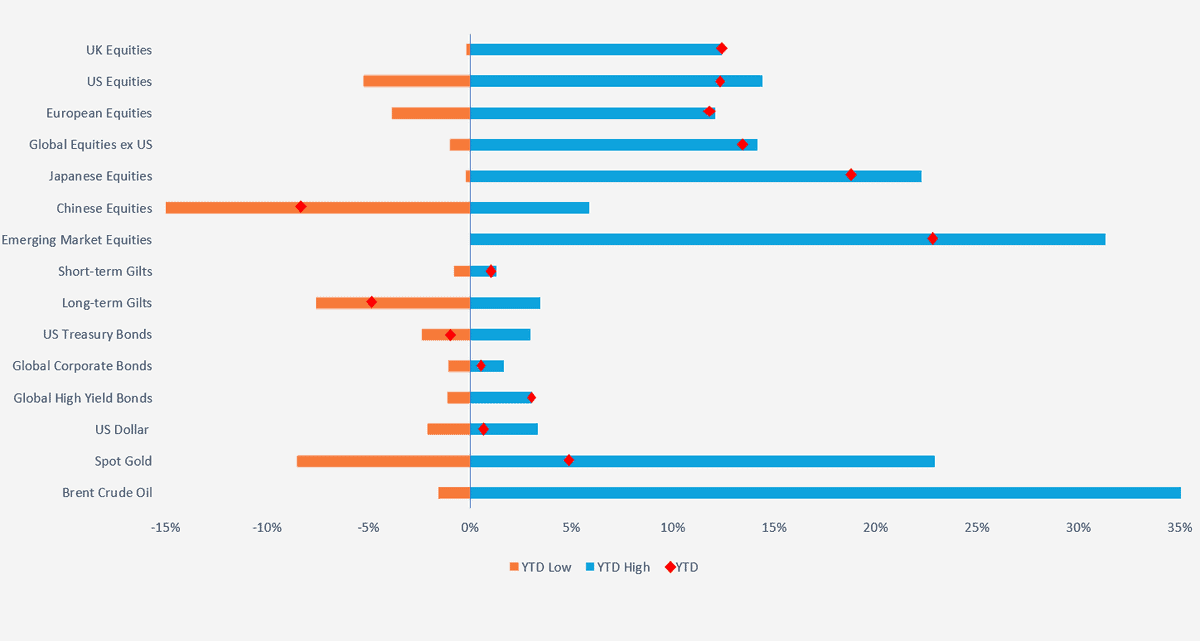
Selection of assets 2026 YTD returns and range of returns as at 27.08.2026 (the two ends of the bars represent the range of YTD returns and the red dots represent the current YTD return). Indexes used: FTSE All-Share, Russell 3000, STOXX Europe 600, MSCI World ex USA, MSCI Japan, MSCI China, MSCI Emerging Markets, FTSE UK Conventional Up To 5 Years, FTSE UK Conventional Over 15 Years, ICE BOFA US Treasury, ICE BOFA Global Corporate Hedged GBP, ICE BOFA Global High Yield Hedged GBP, US Dollar Index, S&P GSCI Gold Spot & S&P GSCI Brent Crude Spot. Returns hedged back to GBP with exception of US Dollar which is in US Dollar terms. Returns based on daily data. Source – Watson French with data from FE Analytics and MarketWatch. Data correct as at 27.08.2026). The YTD point for Brent Crude Oil is not shown as its YTD return is 77.11% and including this would distort the chart too much.
–
US
US inflation had a much-needed decline down to 3.4%, with core inflation falling from 2.5% to 2.4%. The Fed’s preferred measure of inflation, personal consumption expenditures inflation remained at 3.7% (3.3% excluding food and energy inflation) in July.
As usual changes in inflation rates lead to changes in the probability of future rate cuts but it doesn’t address the issue of volatile inflation. If inflation continues to tick down Fed chairman Kevin Warsh may not need to raise rates this year, instead letting markets do the moving. This is a big “if” though. His rhetoric so far has been on less communication and letting markets do more of the work. This could reduce credibility and trust and as we showed last month, the two year yield picking up shows markets believe the Fed needs to increase rates. If the market starts telling the Fed what to do we will get into hot water.
The AI buildout is driving economic growth in a positive way but how the companies are funding this expansion is having a much bigger effect on other areas of the markets. AI hyperscaler debt issuance is increasing and because they are issuing such massive volumes of debt, they are issuing it into different credit markets outside of the US.
US corporate bond markets are much bigger than the UK or European markets and issuance in these smaller markets can greatly impact the credit spreads on indices tracking their bond markets. Spreads in the UK and Europe have widened because of the technology companies’ bond issuance. This can cause borrowing costs for other non-tech companies and domestic companies to increase. There are domestic reasons for bond spreads widening as well, but the tech issuance is certainly having an impact. The longer end of the credit curve is being impacted by a greater amount than the short end as technology companies lock in long term lending, such as Alphabet’s century bond. This could result in non-tech businesses delaying their debt issuance and so lead to capital spending, to avoid paying higher yields because of technology issuance.
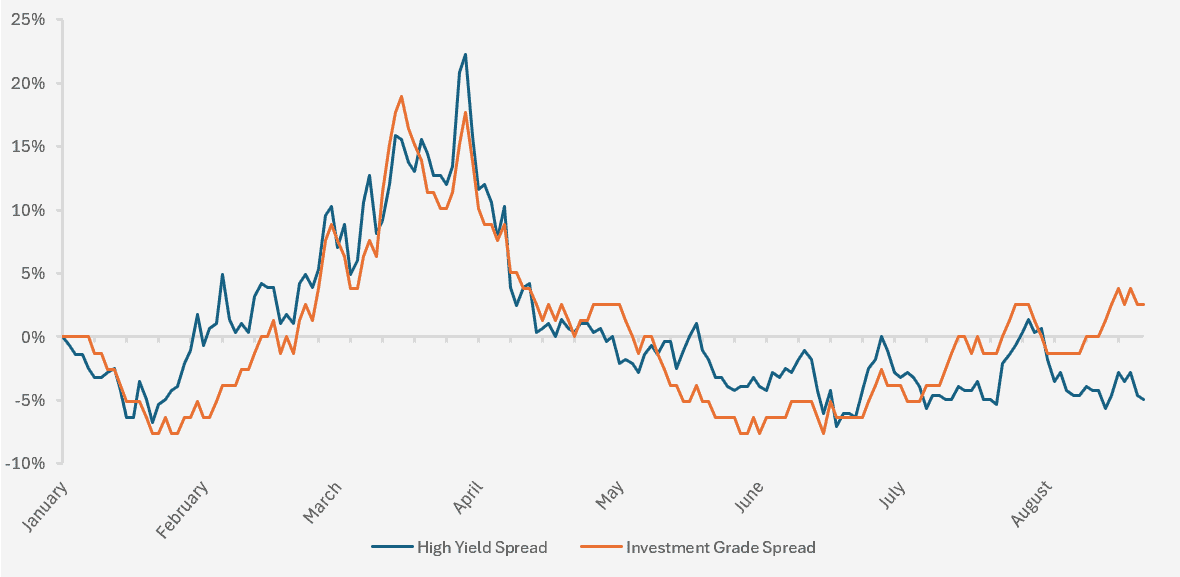
Chart showing the YTD cumulative change in the yield spread of US High Yield bonds and US Investment Grade Corporate bonds over US Treasuries. (Source – Watson French with data from St Louis Fed/ Ice Data Indices. Data based on daily closing yields. Data period runs from 02.01.2026 – 24.08.2026. When the lines falls the yield spreads are tightening and when the lines rise the yield spreads are widening. Yield spread shows the premium over US treasuries for taking on the credit risk associated with corporate bonds).
Despite lower credit risk in investment grade debt relative to high yield debt, recently we have seen the yield spread over US treasuries widen for US investment grade debt and tighten for US high yield debt. We think this is the influence of the AI hyperscalers’ debt issuance. Spreads on nearly all of the big technology companies’ recent bond issues has widened which has pushed investment grade bond yields upwards. None of their debt is rated below investment grade, leaving the wider high yield indices intact.
Historic research has pointed to spreads on corporate bonds being tighter when US government debt levels are higher. This could mean that spreads don’t widen as far as markets think they could in a crisis, but what we do know is that further tightening from here is unlikely.
For many markets, technology-related debt was previously extremely small. But it is now accounting for an increased amount of issuance. In some ways this provides diversification within the index, but indices are becoming more concentrated in technology companies and this means that what happens with the AI theme will have a greater impact on passive bond indices and returns. It also means that where bonds were previously used to diversify away from equities and provide some form of protection if the AI theme lost steam, they are now becoming more correlated with what is happening in AI and arguably more risky.
The downside for equities is 100% but upside is potentially unlimited, as the equity holders benefit from earnings growth. For bond holders the downside is 100% but the upside is limited, as they have no claim on earnings or future growth.
As the world gets taken over by technology, assets become more correlated through those which rely on technology and the proportion that technology assets make up in an index. It is crucial to know what you own in a portfolio, otherwise you can easily be subject to over-exposure.
Another consequence of higher corporate bond issuance is that US government debt has more competition, and this is one of the many factors pushing yields higher, especially at the long end.
US Treasury Secretary Scott Bessent enjoys intervening in markets and has again directed the treasury to double its purchases of long term government bonds. Initially longer term bond yields fell on this news but in order for meaningful reductions in longer dated debt yields there needs to be structural changes. An example of this is the size of US government debt, which reached over $40 trillion. Investors have likened this to putting a plaster over a bullet hole.
The hard options to solve the level of debt will be higher taxes and slower government spending, something we don’t see as likely given the US competition with China and political pressures to please voters. Higher inflation will keep yields higher and interest rates higher, and this will make the interest cost on the debt expensive (which in 2025 accounted for around 3.15% of GDP according to the US Office of Management and Budget). Bessent did say the government would focus on fiscal consolidation and that there is a very good chance the US has reached the peak of its government deficits. We think this is highly unlikely. Tariff revenues won’t fix this and other than the above points, we don’t see this is likely. If Bessent doesn’t deliver on his words the US Treasury will lose some of its credibility.
There are fundamental liquidity concerns at the longer end of the yield curve, especially at 30 years. Improved overseas domestic yields, higher corporate debt issuance and less structural demand (defined benefit pension schemes, higher private credit and other private asset volumes) alongside higher volatility in long dated debt means the demand for this long dated debt is much weaker.
We think Bessent is focusing on market signals and not US policy. The Treasury may issue more short term debt to counter the purchases of longer term debt, but this would increase US interest rate volatility.
We see why investors don’t want to hold long term government debt. Real yields are positive but the volatility and threat of increasing interest rates don’t quite compensate for this. We think the term premium has further to rise to compensate for this volatility. We don’t agree with the premise that investment grade corporate debt (and specifically tech-related debt) is a replacement for government debt. If markets experience a drawdown, corporate bonds will be impacted just as equities will. If corporate earnings are lower and the credit risk is higher spreads will widen and result in capital losses. The hyperscalers cannot print money and in a crisis, investors flee to safety. Other than cash this leaves government bonds.
Inflation expectations are embedded in bond yields but they have not moved up too much lately.
We spoke previously about some innovative financing strategies from technology companies including off-balance sheet debt, vendor financing and companies being guarantors on another company’s debt (cough Nvidia, cough circular financing). Another innovation we continue to find concerning is the single-stock leveraged ETF. The premise of this is that it magnifies returns by using derivatives, but it also magnifies losses. This is a good example of manufacturing returns in an environment where investors simply are not happy with the returns they are getting. This is a sure sign of greed.
There are now over 6,000 ETFs in the US with more than 1,100 added last year according to Goldman Sachs. They now outnumber the number of actual companies in the US.
On a quick note for circular financing, Nvidia released its quarterly earnings which again beat analyst expectations. There have been concerns regarding Nvidia using its own balance sheet to help companies buy its products. The Nvidia Chief Financial Officer said “We recognise the scale of this support and we know some will call this circular financing. We see it differently”. She said the investments will be “excellent” with “limited risks”. These sort of statements are deeply concerning. When confidence is high risks can appear smaller than they actually are. If one company in the chain fails we could quickly see a domino effect and demand for Nvidia’s chips could rapidly fall away. Not only that but Nvidia is a guarantor on a lot of the debt which they would need to repay all while their revenue falls.
From the Dot Com bubble, business leaders and investors have focused on the transmission mechanisms which occurred then and have been fixed, but they have forgotten about the ones that were not fixed.
–
UK
Central banks hold a lot of government bonds from their previous quantitative easing exercises (buying government and corporate bonds to put money into the economy). If they already hold large volumes the question arises as to what would happen if we saw a major financial crisis and market drawdown. What effect would their buying of government bonds have on markets and yields? If a balance sheet is already large then when quantitative easing is used in the future, it will require larger and larger purchases to have the desired effect on yields, which causes further pain when this larger volume is sold again in the future.
With the Bank of England needing to decide whether it will continue its active selling of bonds to shrink its balance sheet, it needs to balance the above fact with the fiscal losses that come with selling bonds below their par values and the increase to bond yields active selling has.
UK economic growth continues to tread along with positive growth of 0.4% for the second quarter, building on the 0.6% growth in Q1. Growth for June at 0.3% was buoyed by the World Cup. If growth and the labour market hold up, it puts less pressure on the Bank to cut or even hold rates if inflation remains above target. The Bank of England believes inflation will rise from 2.6% to 3.2% by the year end. But the budget in October is expected to cause movements in all markets, with a new Prime Minister and Chancellor at the helm wanting to make their mark. Just the idea of the Budget will cause uncertainty and delayed investment, well before any actual policies are announced. The UKs merry-go-round politics is dampening growth and the need for stability and a clear path is key.
–
Japan
The month started with the US buying Japanese Yen in a bid to prop up the Yen which has weakened throughout the year versus the US Dollar. The US did this by buying Japanese Yen and selling Euros, not US Dollars.
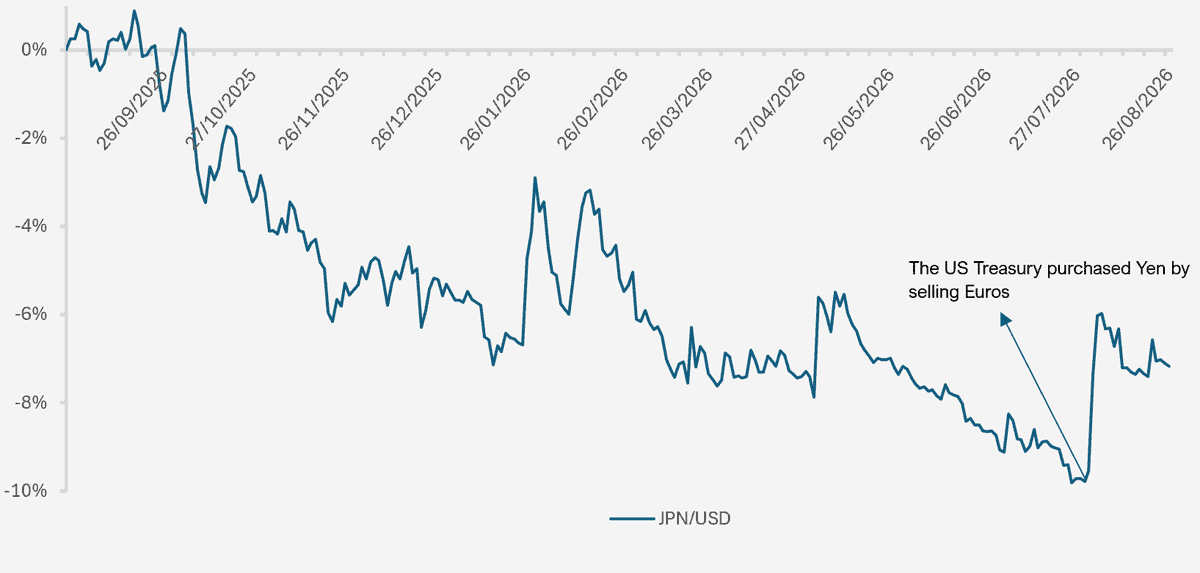
Chart showing the cumulative change in the JPN/USD exchange rate over a one year period. (Source – Watson French with data from Investing.com. Data period runs from 26.08.2025 – 26.08.2026 and is based on daily opening exchange rates. When the line is falling this shows a weakening of the Yen versus the USD and means it costs more Yen to buy one USD, making imports more expensive).
Markets have read a lot into why the US Treasury Secretary Scott Bessent did this but as we can see in the chart above, while there was an initial strengthening in the Yen, relative to the performance over the whole one year period it did little to reverse the trend.
This may seem trivial but it is one of the biggest risks to asset prices – not the fall in the value of the Yen directly but the resulting rise in the Japanese government bond yield. This rise could easily pull Japanese capital out of US and other global assets and back into Japan. This matters because Japan holds well over $1 trillion of US treasuries and is the biggest foreign holder. It isn’t just about what they hold now but what they will hold in the future. Global governments are increasing their borrowing to fund expenditure on defence, infrastructure, social care etc. rather than increasing taxation and they need someone to buy this debt. If the demand weakens then the cost of issuing this debt becomes more expensive; more of the tax receipts and borrowing the governments have is spent on repaying the interest on this debt, and overall growth weakens. Company borrowing becomes higher and unemployment potentially rises. It essentially turns into a vicious cycle until we see a big reset.
Along with what we talked about in the US section this puts big pressures on US bond yields.
Globally governments are looking to issue more short term debt and it may have less interest rate sensitivity to movements in yields for investors, but for governments it increases the rollover risk. That is, it may become more expensive to take out new debt when the existing debt matures if rates are higher. This is especially true given government debt issuance in the pandemic was high when rates were near zero.
The reason for the weaker Japanese currency stems from economic fundamentals, as a big driver of currency strength is because of interest rate differentials. Interest rates are higher in the US than they are in Japan. US rates may well stay higher if not increase and Japan seems reluctant to raise rates too high too soon as they are balancing their inflation and economic growth at a time when their energy imports are more expensive. The Japanese Prime Minister Sanae Takaichi also wants lower rates to spur economic growth. If investors can earn more in US Dollars than Japanese Yen then they will sell the Yen and buy the Dollar.
The Japanese Treasury can prop up their currency in two ways. The first is to increase interest rates and the second is to sell US assets and buy more Japanese government bonds. The first option could damage economic growth and pull inflation back down which, after decades of fighting deflation, is a big concern. The second option risks the wrath of Donald Trump, who has in the past punished so-called “currency manipulators” such as Switzerland. It is a difficult situation for Japan but why the US has stepped in is puzzling.
So the reason Japan’s currency is weak is to do with economic fundamentals and if fundamentals do not improve, any short term buying of the Yen will be matched by the market selling the Yen on the other side, and indeed this is what we have seen. Investors want higher interest rates to combat the potential for inflation overshooting the 2% target. At its last meeting the Bank of Japan voted to hold rates as they are, with just one member voting for an increase. A weaker Yen also increases Japan’s cost of imports which will add to inflationary pressures. With inflation rising, the probability of a rate increase at the next meeting has increased.
The US sold Euros likely because it didn’t want to sell its own assets and put pressure on its currency and yield curve. This shows a risk for the US, that, if push comes to shove and other economies need to sell US treasuries, the yield could go a lot higher.
We have to look through Bessent’s comments that intervention with the Yen was because of the two countries’ friendly relationship. Governments are not selfless and the US is certainly no exception. With Trump wanting lower rates and Kevin Warsh confusing markets with his first Fed statement and lack of guidance, the US is scrambling to retain capital in their growing treasury market. The US’s actions are like one of those gangster movies where someone pulls their jacket to the side to reveal their gun tucked into their belt. No prizes for guessing who the gangster is in this analogy.
The Bank of Japan holds 49% of outstanding Japanese government bonds and will likely continue to shrink its holding, which will put upwards pressure on yields but at a slower rate. The Japanese Prime Minister wants lower rates to boost growth but if inflation keeps rising, rates will have to go up.
We also see risk in the Yen carry trade, which involved borrowing cheaply in Yen to buy assets in other currencies with higher interest rates. This trade is highly leveraged to enhance the returns and sudden changes in interest rate policy could spark a large sell-off.
–
Robert Dougherty, Investment Director
September 2026
This article is not a recommendation to invest and should not be construed as advice. The value of an investment can go down as well as up, and you may get less back than you invested. Data is correct at time of writing and cannot be guaranteed.