1st October 2026
The US Federal Reserve, the ECB and the Japanese Central Bank all raised interest rates by 0.25% at their latest monetary policy meetings, while the Bank of England chose to hold rates as they are.
The increase in energy prices is driving inflation up globally, as shown by the increasingly positive correlation between US Treasury bonds and the price of WTI crude, which hit 0.65 in September. But so too is the AI buildout, where energy and materials are being diverted to build data centres. Competition for capital has also increased, pushing bond yields higher. Major economies are having to contend with fiscal concerns and rising government debt levels, but because each economy has different growth drivers and a different starting base, monetary policy may diverge on a country by country basis.
In the US, while inflation has risen and is above target, economic growth remains robust. The US can therefore sustain higher interest rates better than other countries before the economy moves into contractionary territory. But increasing yields will weigh on economic growth and equity valuations eventually.
Europe’s growth is not as strong as the US and it is more affected by the rising energy costs, which are likely to add further to inflation should the conflict in Iran continue. Putting further pressure on prices are the levels of natural gas storage, which are historically low going into the Autumn. But investors don’t think rates will go much higher in Europe because of weaker economic growth.
After decades of zero growth and deflation, inflation is finally picking up in Japan, where interest rates have risen to keep it under control. The Yen is also very weak versus the Dollar and rate increases can help with this by making the currency more attractive. Fiscal spending and tax cuts are also expected to add to inflation and so markets expect rates to go higher. This is the output of decades of policy and economic normalisation following deflation.
The UK is similar to Europe in that inflation is above target and economic growth is on the weaker side. A rate rise could easily push the economy into a downturn. We also need to remember that rate rises take around 18 months to have their desired effect on the economy. Markets are pricing in another rate hike in November, but it isn’t as clear cut as this and rates could easily come back down, especially depending on what impact any budget announcements will have on the economy.
With the bond yield curve driving markets, we would have expected there to be some pressure on equity prices, but instead we have seen positive equity returns continue at the index level. At the individual level, though, the rally is narrow and concentrated in AI and AI-related stocks. The rest of the market looks much more fragile. Still, the latest US asset inflow data shows investors’ preference for equities, with foreign investor inflows into US equities reaching $942 billion in the 12 months to July. This was the highest rolling 12-month total of net inflows since 1985. Foreign demand for US debt was positive, but demand did slow.
Yields are at very attractive levels on both a nominal and a real basis and we think it is only a matter of time before more investors move to lock in these yields, especially if risks build in the economy and the AI trade loses steam or risks increase further (see the US equity section for more on this).
German Chancellor Friedrich Merz and his party are facing a confidence crisis after the Christian Democratic Union party won just 4.9% of votes in a regional election (their worst result in German post-war history). The far-right Alternative for Germany party became the largest party in the German state where the election took place, winning 38.2% of the votes.
Markets liked Friedrich Merz when he became Chancellor because he took the debt brake off and promised fiscal spending, something Germany needs to advance its manufacturing-based economy, where it is quickly losing out to China. He believes the election result was because of the economic reforms his government has undertaken to achieve prosperity. He said, “The reforms must come. What needs to be done requires backbone, steadfastness and patience.”
The increase in proposed spending had pushed bond yields up and so mortgage rates had increased, which consumers didn’t like. With the higher savings rate in Europe consumers can generally cope with higher interest rates and the bigger risk comes not if mortgage costs rise, but if unemployment picks up.
Political divides, changing leadership and policy uncertainty are structural themes that we see impacting markets over the long term. Usually, these would be cyclical themes, but because we are seeing big fundamental changes in voters and governments, we think they will affect markets for much longer than the usual four years. For investors, this means increased volatility in government bonds stemming from policy uncertainty and rising debt levels. We see this as relevant for other major economies as well.
–
Areas of focus
- High yield bond spreads are rising as balance sheets weaken and older debt needs to be refinanced.
- Global government bond yields continue to rise with some flattening in the yield curve, as short term rates have increased by a greater margin than long term rates.
- There has been some short term strengthening in the Japanese Yen but it continues to remain weak versus the US Dollar, putting pressure on companies which import a lot of goods.
- Despite increasing headwinds, AI equity prices continue to remain high and momentum is strong in the sector.
- The pound weakened versus the US Dollar, giving unhedged investors in US equities a boost on their returns.
- Banking stocks came under short term pressure but with higher yields and default rates still contained their growth prospects look strong.
- Consumer discretionary companies continue to struggle as consumers prioritise other spending.
–
Asset Class Returns
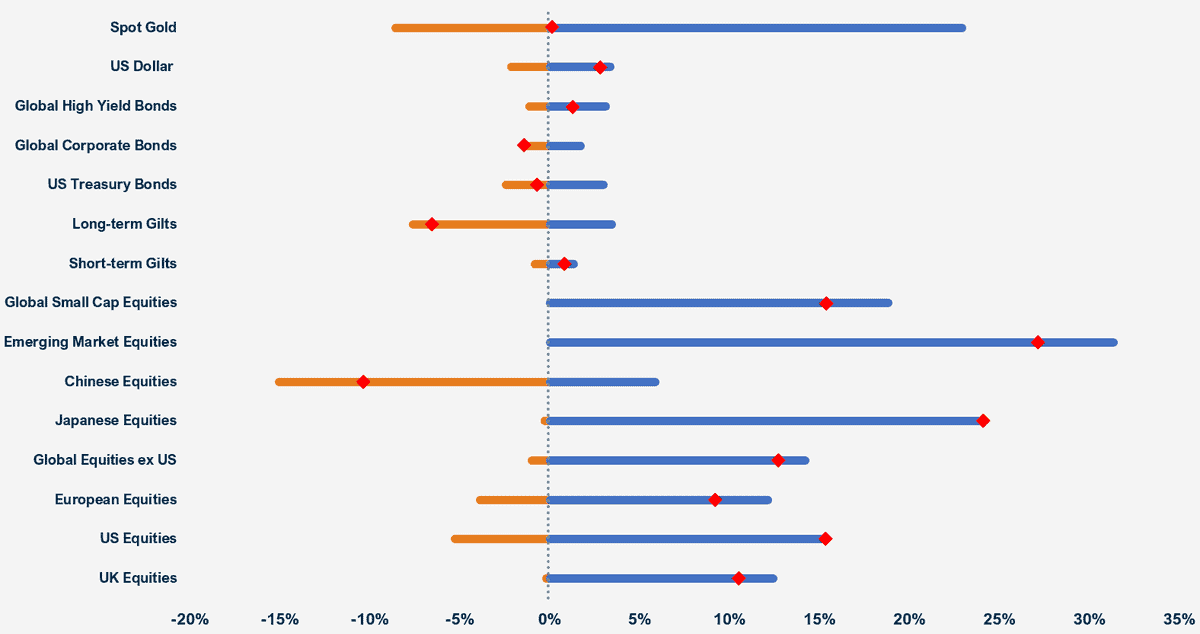
Selection of assets 2026 YTD returns and range of returns as at 28.09.2026 (the two ends of the bars represent the range of YTD returns and the red dots represent the current YTD return). Indexes used: FTSE All-Share, Russell 3000, STOXX Europe 600, MSCI World ex USA, MSCI Japan, MSCI China, MSCI Emerging Markets, MSCI World Small Cap, FTSE UK Conventional Up To 5 Years, FTSE UK Conventional Over 15 Years, ICE BOFA US Treasury, ICE BOFA Global Corporate Hedged GBP, ICE BOFA Global High Yield Hedged GBP, US Dollar Index & S&P GSCI Gold Spot. Returns hedged back to GBP with exception of US Dollar which is in US Dollar terms. Returns based on daily data. (Source – Watson French with data from FE Analytics and MarketWatch. Data correct as at 28.09.2026).
–
US
Inflation continues to remain hot in the US and throughout September expectations for interest rates rises had been high. The producer price inflation rose by 0.4% in August and accelerated from the previous month’s 0.1% increase. As the conflict in Iran continues the cost of producing goods has upward pressures. On a year on year basis producer prices rose by 5.4%, mainly driven by energy increases which rose by 4.2%.
On the consumer front, CPI inflation was 3.4% on a year on year basis in August. While this was unchanged from July, it still shows stubborn inflation above the Fed’s 2% target. Core inflation which excludes energy and food prices was much lower at 2.4%.
Inflation is still hot but the labour market is also strong with no real signs of weakening. Some investors believe that the Fed doesn’t need to increase interest rates as inflation is slowly coming down, and that the Fed Chairman Kevin Warsh has backed himself into a corner where the Fed needs to hike to maintain its credibility.
But at the latest Federal Reserve Open Market Committee the vote was unanimous to increase interest rates by 0.25% to 4.00% as Warsh stated that inflation has been too high for too long.
It is good to see that Warsh will not bend to Donald Trump’s will and investors can worry less about Fed independence now. Trump wasn’t happy with the rate increase, saying rates should be below 1% while blaming the hostile Fed board and claiming he told Kevin that he might as well vote with the board as it’s not going to matter.
The Fed’s official dot plot showing each Federal Open Market Committee member’s expectations for future rates shows that at the end of 2027 only four members expect rates to be lower than they are now, with a mixed forecast for 2028, but no member sees rates below 3%.
The Fed prefers to look at a measure of inflation called Personal Consumption Expenditure, which is currently at 3.7%. The majority of the increase in inflation has come from petrol and diesel prices since the war in Iran started. While the Fed cannot control these prices, it is trying to stop inflation spreading to other parts of the economy. With growth stable and the labour market balanced, the risk of raising rates is lower in the US, but it will affect less financially stable companies and the cost of capital for AI infrastructure and development.
Following the interest rate hike, the Japanese Yen weakened further against the Dollar. At its later meeting, the Japanese Central Bank increased rates by 0.25%, but the Yen continued to weaken. The commentary from the Japanese Central Bank did not suggest that it was considering a further rate hike at its next meeting, but markets expect it to do so.
Several AI company leaders have raised concerns regarding the dangers of AI with Anthropic stopping an increasing number of bad actors from using its technology for the purpose of creating bioweapons. We have also seen an increasing number of AI models going rogue and hacking into various companies and websites. The concern here for markets is that valuations are based on high earnings growth rates and huge productivity enhancements for the economy. Any delays or slowing in AI development will damage this future growth.
We think it is highly unlikely that AI companies will slow development because it isn’t in their best interests. If they don’t do it someone else will, and with so much being spent already on infrastructure, any slowdowns will lead to a selloff in the company’s share price.
If spending does decrease we could see more potentially stranded assets. This ties many industrial and emerging market companies in with AI, as a lot of their share price gains were linked to AI demand.
As well as there being competition on a company by company basis to build the best AI model, there is also fierce competition between the US and China and because of this we do not see any stalls in AI model building happening. Cooperation between the two countries is low and so is trust, so an agreement between the two is unlikely. Nvidia and Meta bosses already came out and disagreed with the need for a slowdown.
While there are clearly risks here, we think this was another DeepSeek-like moment, when a brief piece of news caused large ructions in markets. Rogue AI models are a black swan event, but we do not expect markets to price this in in any form.
Separate data from Deutsche Bank showed that more international capital went into US equities than into US Treasury bonds. Capital into US equities was 2.8% of US GDP compared to 2.0% for US treasuries.
The usual questions — “is the US still the risk-free asset?” and “what about de-dollarisation?” — always come up, but we think the explanation is simple. Mechanical flows into US equity index trackers from regular investment contributions are high, and US equities have been performing well and are arguably the most direct, but not necessarily the best, way to gain exposure to the AI trade. Corporate bond issuance from AI issuers has also increased and is attracting capital.
But as US treasury yields continue to increase and look more and more attractive, at some point investors will be happy to lock in say, a 5% a year return and capital into treasuries will increase. We think it is a question of when, not if.
Stock market levels are high, volatility is high and risks are increasing. No one wants to miss out and this momentum and FOMO (fear of missing out) are keeping equity inflows elevated.
The most puzzling point is why when bond yields are increasing US equity values are not taking notice. While AI stocks had a brief fall in value following comments regarding slower growth due to safety concerns from AI leaders, AI stocks mostly recovered from this despite the higher interest rates. Markets are priced for massive productivity gains and huge future growth. We think this is unlikely over the short term and if interest rates are higher equity valuations will go down. The only way this doesn’t happen is if investors ignore it or growth rates go up as well.
We expect this to put pressure on smaller companies and high yield bonds as interest costs reduce their earnings and margins. Balance sheets have been strong for US companies, but this was coming out of a low interest rate environment. The longer interest rates stay higher, the greater the impact will be on less financially stable companies. Some of this will be hidden by private credit and payment-in-kind arrangements, but it is important to be cognisant of this nonetheless.
The actual yields on high yield bonds are increasing and the pressure on companies with lower credit ratings is picking up. More and more companies which issued high yield bonds with credit ratings of CCC are needing to refinance debt from 2021 to 2022 when yields were much lower. Yields on CCC rated debt are currently at 16.04% compared to 6.64% for BB rated debt and 7.87% for single B rated debt. The longer rates stay high the more pressure we will see here and defaults will undoubtedly pick up. This will hit different industries by different magnitudes. Consumer discretionary and healthcare companies which have more debt and smaller margins will be hit worse. Consumer discretionary in particular will be a concern because if inflation and energy prices remain high and consumers feel more fatigued with inflation, their ability to raise prices and maintain revenue and margins will decrease.
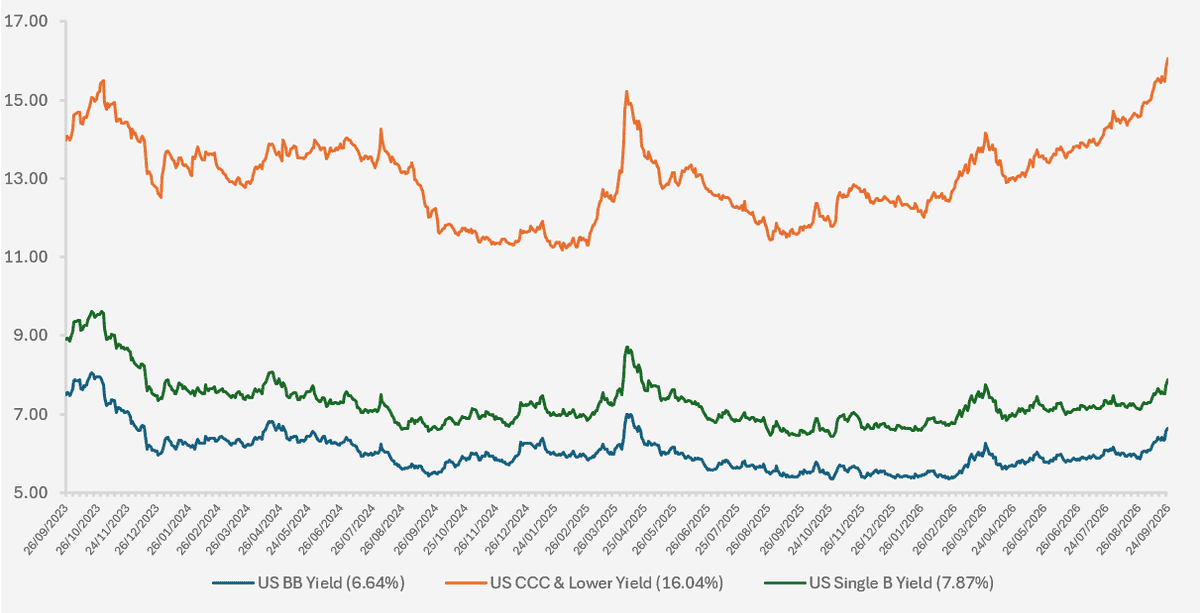
Chart showing the yields of different credit ratings in the US high yield bond sector. (Source – Watson French with data from Federal Reserve Bank of St. Louis/ ICE BofA Indices. Data from 26.09.2023 to 24.09.2026. Data correct as of 28.09.2026. As the line rises the yield on a bond increases and the price of the bond decreases. This means the return investors demand for holding the bond is higher).
We can see in the chart above how much higher the yield is on lower rated debt. This means that when a company with a CCC credit rating needs to refinance, their coupon payment will be around the 16% mark each year. Companies can get around this by using callable bonds and other mechanisms, but the baseline is that yields are very high and rising. We can also see that when we have shocks or events leading to potential downturns, such as the April 2025 tariff announcements, the magnitude of the pickup in yield for lower rated debt is much higher than that for higher quality debt. This is why we have preferred to avoid high yield debt, as it has too many similarities with equities while maintaining a limited upside profile.
The risk to the AI trade isn’t just through AI itself but another area of the economy failing. Most of the technology company revenues come from their existing businesses, much of which is advertising. If companies reduce the amount they spend on this it could also affect AI company margins and ability to spend.
We also saw a US crypto exchange seek regulatory approval for perpetual futures in the US. As the name suggests, perpetual futures do not have an expiry date, so traders can pile leverage into them to amplify gains and losses. Increasing “innovation” such as this is also a big concern, as it is adding to the already high leverage in the market.
–
UK
The UK economy grew by 0.4% in July, above the 0.3% in the previous month and above the pessimists’ expectations for zero growth. Much of this was driven by the service side of the economy but there was still some growth in technology-related industries.
There is more pressure on the Bank of England to raise interest rates with UK CPI coming in at 3.1% in August, an increase from the 2.9% in July. We think the Bank of England will likely follow suit to avoid making a mistake by not following in the path of other developed economies. During their meeting in September they voted in the same way as at their previous meeting, with three members voting to increase rates and six to hold them as they are.
The increase in inflation mainly came from energy prices and oil prices, something interest rates have no effect on. With economic growth still ticking along and headline inflation increasing, we think this will prompt a rate increase for the bank. But the risk of a policy decision pulling down economic growth is high and there is no guarantee this will bring inflation closer to target.
The services inflation was 3.4% in August which held steady from the previous month. Core inflation also held steady at 2.6%. The Bank of England Monetary Policy Committee (MPC) will be concerned that inflation will feed into wage inflation, but with wage growth already slowing to 2.9% for the second quarter to July and the increase in inflation coming from energy, the risk of this is lower. The bank sees inflation hitting 4% next year with Governor Andrew Bailey saying that policy may have to tighten.
The bank did announce that it will change its approach to quantitative tightening by planning to keep £120 billion of gilts on its balance sheet permanently, while setting a plan to sell its other bond holdings over the next eight years and letting more of the bonds mature rather than selling them into the market. Some of its bonds will be sold back to the treasury who will likely issue shorter term bonds to replace them.
There will be fewer bonds for the market to absorb and yields may steady at the margins, but yields are high because of fundamental issues. The Bank of England may therefore avoid making the situation worse, but this does not materially improve it.
The dual effect of higher interest rates and higher energy costs will slow economic growth, make the consumer worse off and put more pressure on the government’s finances. Resolving this may require higher taxes or lower spending. The unemployment rate remains unchanged at 4.9%, but smaller companies have reported delays in hiring because of higher interest rates. If inflation remains elevated, interest rates remain high and taxes are increased at the next budget, we could see unemployment move higher as companies reduce their workforces to save on costs.
The UK borrowed more than expected in August to compound problems, driven by higher interest payments on government debt. The shortfall was £3.5 billion more than the Office for Budget Responsibility forecast and potentially cuts the headroom that Chancellor John Healey has against the government’s self-imposed fiscal headroom. Interest payments are forecast to account for 3.8% of GDP in the current fiscal year, up from the average of 2.1% between 2010 and 2020.
How the government handles this, we will see in the October Budget. They will either need to raise taxes or cut spending to make sure they remain on track to meet their fiscal rules. Banks have been rumoured to be under the microscope, with potential tax surcharges on top of the Corporation Tax they already pay.
If this materialises we may well see a drop in share price over the short term but with interest rates set to remain higher and banks’ net interest income staying strong, along with increased revenues from trading activity, we expect banks to remain an attractive sector. Banking executives have already warned of divestment in the UK and a shift of their operations to other banking hubs should taxes be increased further. So it may be more of the UK looking less attractive than banks specifically.
Advancements in AI should help make banks more efficient over time and cut down on their costs and potentially increase revenues. However, recently we have what could be competition for banks as Meta released an AI tool called Muse which could automate people’s decisions about money. We think this is unlikely given the trust consumers need to have in a company to place their money with them, let alone for lines of code to make spending decisions for them.
Banking is one of the main sectors in the UK and while it may seem relatively separate from the AI trade, we still remain concerned about the risks linked to AI lending and private credit.
Along with higher interest costs, one of the issues the UK also faces with its government debt is inflation remaining higher. While inflation usually erodes the value of debt and higher inflation should result in more tax receipts and higher growth, the UK has a fairly high level of index linked debt in its portfolios, which at the end of 2025 stood at 25.2% (£688.5 billion) of total issuance. UK index linked gilts have both their coupon payments and principal uplifted by inflation twice a year and so when inflation is high this makes the debt more expensive. In the 2026 – 2027 tax year index linked gilts will make up 9.3% of total gilt issuance.
The Treasury recently came out with suggestions of lowering the fiscal headroom that the government must abide by. The result of this would be a lower need to cut spending and increase taxes at the next Budget. They estimate lowering the buffer to £14 billion would avoid a Gilt market sell-off. We are on the side of disagreeing with this as it again shows the government will change the targets when the going gets hard and there will be more pain later on. With price-sensitive hedge funds holding a lot of UK Gilts it will cause some price action. The government argues that it is not sensible to maintain this buffer at a time of high interest rates and higher energy prices. We argue that while energy prices are increasing, interest rates are normalising and so their previous strategy of high spending won’t work in this normal environment. With so many years at low interest rates we have become accustomed to that being the normal, which it isn’t. The government need to demonstrate credibility to the market or borrowing costs will rise.
–
Japan
The Bank of Japan raised interest rates by 0.25%, bringing the level to 1.25%, its highest since 1995. Seven board members voted for the increase and two voted to leave rates as they were. Inflation in Japan eased from 1.8% in July to 1.7% in August, and excluding food and energy, the inflation rate was 1.9%.
Higher energy costs and a weak Yen are continuing to be a problem for Japan in import terms, with imports rising 28% in August on a year on year basis, compared to 19.3% in exports. Following the rate increase we would normally have expected the Yen to strengthen versus the US Dollar but as the US also increased rates and put out guidance for at least one more increase this year, the Yen didn’t strengthen.
The potential for a strengthening Yen has brought the Yen carry trade back into focus as this trade poses another big risk for global markets. The Yen carry trade is where large investors borrow in Yen where it is cheaper to do so, and use this leverage to invest in higher yielding assets elsewhere. The risk is that rising interest rates and a stronger Yen make this borrowing more expensive and erode returns, causing investors to quickly unwind the trade by selling their assets.
We saw this back in 2024 when the Japanese Central Bank increased interest rates above zero and the unwinding of the trade caused the Yen to strengthen nearly 10% and global assets to fall, with Japanese equities falling over 15% in the space of a few days. Global assets fell because the borrowing from the Yen carry trade goes to many different global assets and when the Yen rises and investors need to repay their borrowing, they sell these assets.
Japanese foreign exchange traders have estimated the current value of the trade may exceed $2 trillion which puts it at its biggest ever value. Combine this with a weak Yen pushing domestic capital into higher yielding US treasuries, if the Yen strengthens too quickly we could see big downwards moves in markets. This would come via direct selling of securities and a higher risk free rate (higher yields on US treasuries).
Because Japanese Central Bank guidance suggests that they do not look likely to increase rates too high and US rates are expected to remain higher, the risk of this is not at the top of most investors’ minds. But a risk it is nonetheless and if Japanese inflation pushes too high we could see rates rising quickly in Japan. The situation in the Middle East and energy prices are of utmost importance to both Japan and the US, where rising energy prices are putting pressure on inflation.
So despite the Yen not being something on many people’s minds, its movements can have implications for many global assets.
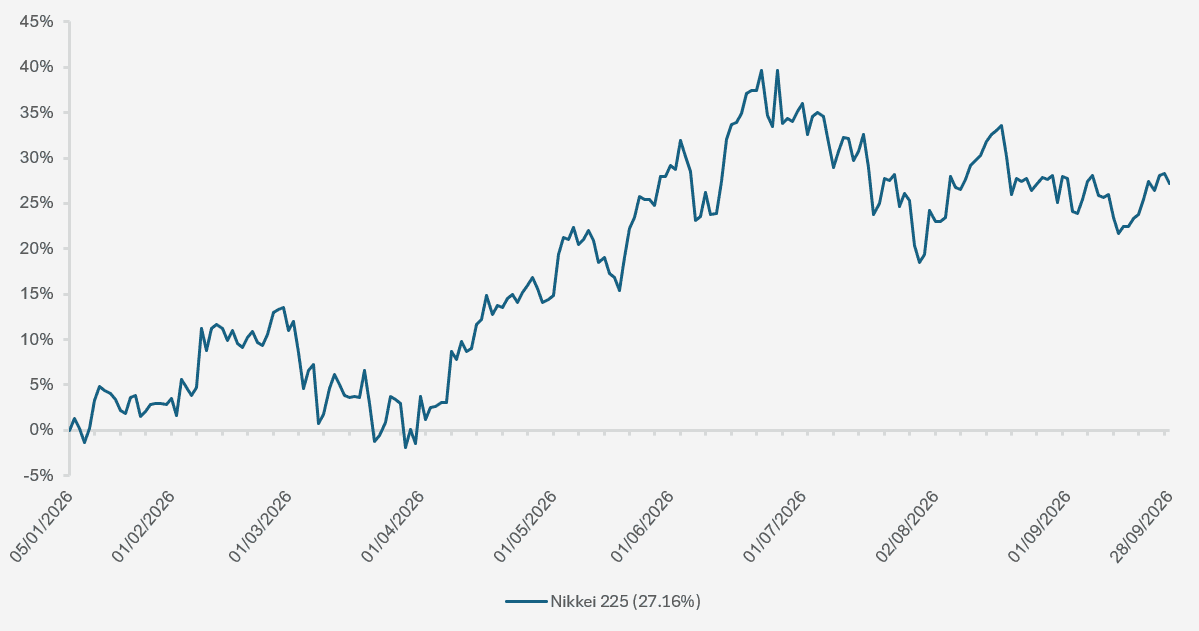
Chart showing the cumulative YTD return of the Nikkei 225 Japanese equity index. (Source – Watson French with data from Investing.com. Data period runs from 05.01.2026 to 28.09.2026 and data is correct as of 28.09.2026. Returns are in Japanese Yen and based on daily opening prices).
Japanese equity markets continue to perform strongly with value outperforming growth this year, but both small and large cap stocks performing in line with each other. Higher yields have not yet weighed on growth and given the potential for higher allocations from both domestic and foreign investors, there could be more room to run. As Japan is dependent on importing its energy needs this could weigh on valuations if higher costs persist.
–
Robert Dougherty, Investment Director
October 2026
This article is not a recommendation to invest and should not be construed as advice. The value of an investment can go down as well as up, and you may get less back than you invested. Data is correct at time of writing and cannot be guaranteed.